|

Electrode Size
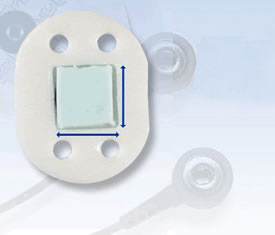
'Electrode size' is defined as the size of the conductive
area of a SEMG electrode. According to literature the size
of SEMG electrodes used in (clinical) practice varies from
1mm2 to a few cm2. The size of SEMG electrodes influences
the recorded SEMG.
Upon an increase of the size perpendicular to the muscle fibres
(bar electrodes perpendicular to the muscle fibres), it is
expected that the view of the electrodes increases. No quantitative
data on the extend of this effect on the SEMG characteristics
is available at the moment.
Upon an increase of the size in the direction of the muscle
fibres, it can be shown that this has an integrative effect
on the SEMG signal, increasing the detected amplitude and
decreasing the high frequency contents.
The European inventory showed that the circular electrodes
with a diameter of 10 mm are preferred most. For bipolar sensors,
in general, the size of electrodes should be large enough
to be able to record a reasonable pool of motor units, but
small enough to avoid crosstalk from other muscles. For daily
use it will be practical to have only one type of electrode
of the same size for all SEMG recordings.
SENIAM recommendations
for electrode size
The SENIAM recommendations for sensors restrict to bipolar
sensors only. 'Electrode size' is defined as the size of the
surface of the conductive area of a SEMG electrode.
SENIAM recommends that the size of the electrodes in the
direction of the muscle fibers is max. 10mm.
|